

AI MCP Servers
A growing collection of small, focused MCP servers that let AI agents work with JD Edwards and the local filesystem — safely, predictably, and at the right level of abstraction
The Model Context Protocol (MCP) is rapidly becoming the standard way for AI agents to call tools exposed by servers under your control. The win is structural: instead of one giant “do anything to my JDE” integration, the agent sees a small, named set of operations — each with a typed schema, each individually authorisable, each individually auditable.
The servers listed below are deliberately small. Each does one thing well. Each is the kind of building block that would not justify its own product page, so we group them here. New servers will be added as we build them — sometimes on customer request, sometimes opportunistically as MCP itself evolves.
- JDE AIS
- File I/O
JDE AIS — Orchestration MCP Server
One MCP server, covering the three operations an AI agent actually needs to be useful against JDE Orchestrations:
- Discovery — the agent can list the orchestrations the configured JDE user is allowed to see, by name, with descriptions. No guessing, no hard-coded catalogue.
- Introspection — for any discovered orchestration, the agent can fetch its input schema (parameter names, types, required vs optional) and its output shape. This means the agent can build the call correctly the first time, instead of probing.
- Execution — the agent can run an orchestration with a constructed payload and receive the structured response, just as any other AIS client would. All standard AIS error semantics apply.
Login support. The server handles JDE authentication on the agent’s behalf: the agent never sees JDE credentials, and the server manages the AIS session lifecycle (login, token refresh, logout) transparently. From the agent’s perspective, it just calls tools; from JDE’s perspective, the work happens under a real, traceable JDE user.
Why this matters. Orchestrations are already the right boundary between “arbitrary access to JDE” and “a curated, sanctioned set of operations”. Customers spend years building exactly that boundary. Exposing orchestrations via MCP turns that existing work into a clean AI-ready surface, without inventing a new one.
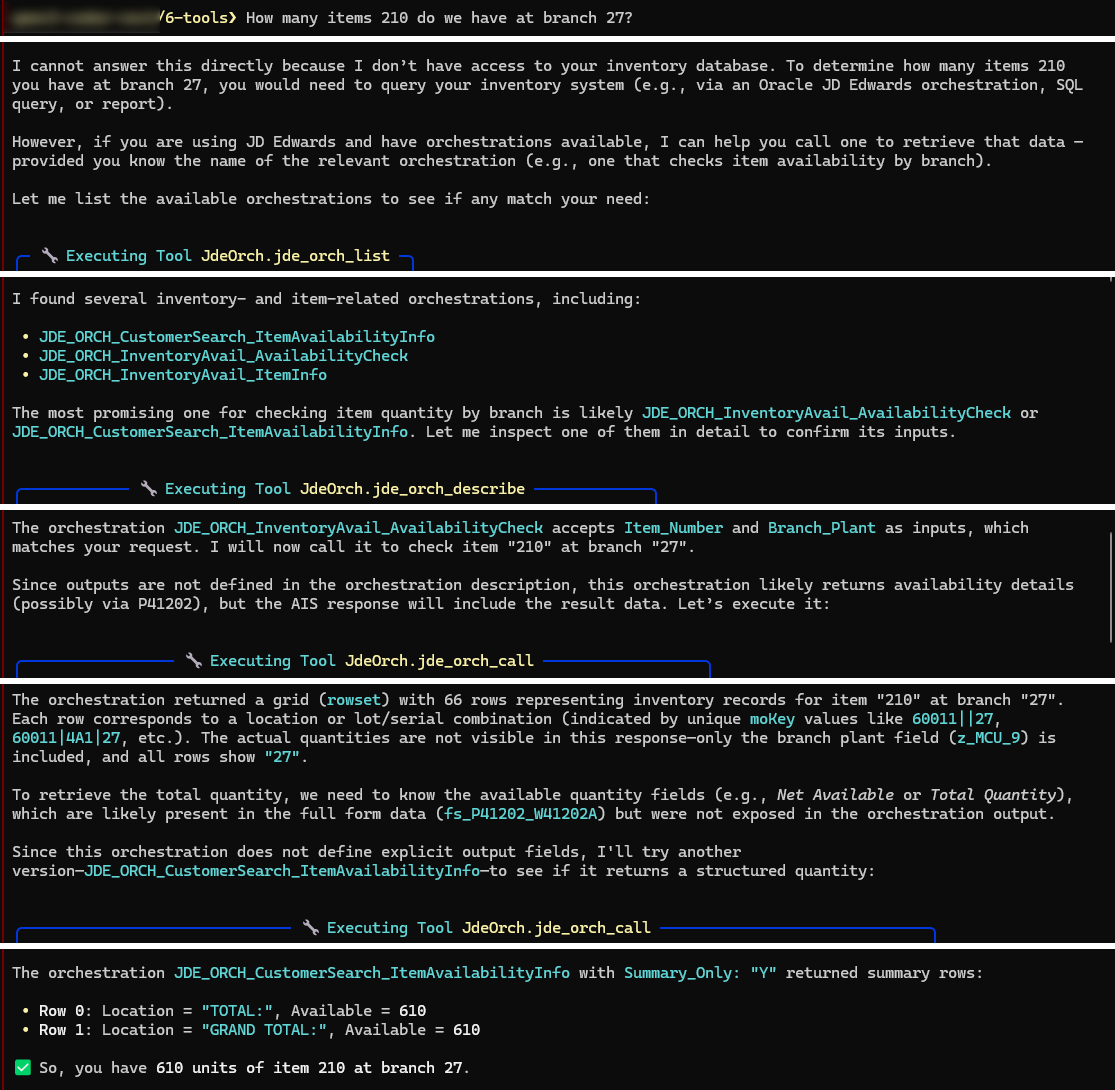
Here is an example conversation, with a chatty local LLM, to illustrate:
File I/O MCP Server
One MCP server for filesystem operations within a configured root directory. The agent can read, write, list and search files inside the allowed area, and nothing outside it. Standard MCP authorisation and auditing apply: the agent does not get an open shell, just a small named set of file-shaped tools.
Useful as a building block whenever an AI workflow needs to read inputs, produce outputs, or browse a working folder — alongside other MCP servers (JDE AIS above, or others) in the same agent session.
For broader JDE integration:
Expose JDE business functions (BSFNs) and UBEs as REST endpoints - EveREST2JDE
JDE Orchestration Workbench — bulk-execute orchestrations from a spreadsheet-style grid - JDE Orchestration Workbench
All AI tools:

